Corner Wall Gallery Ideas: 13 Stunning Layouts That Work
Corners are awkward little liars. They look as though they need “just one picture,” then the picture goes up and the wall beside it suddenly looks even emptier.
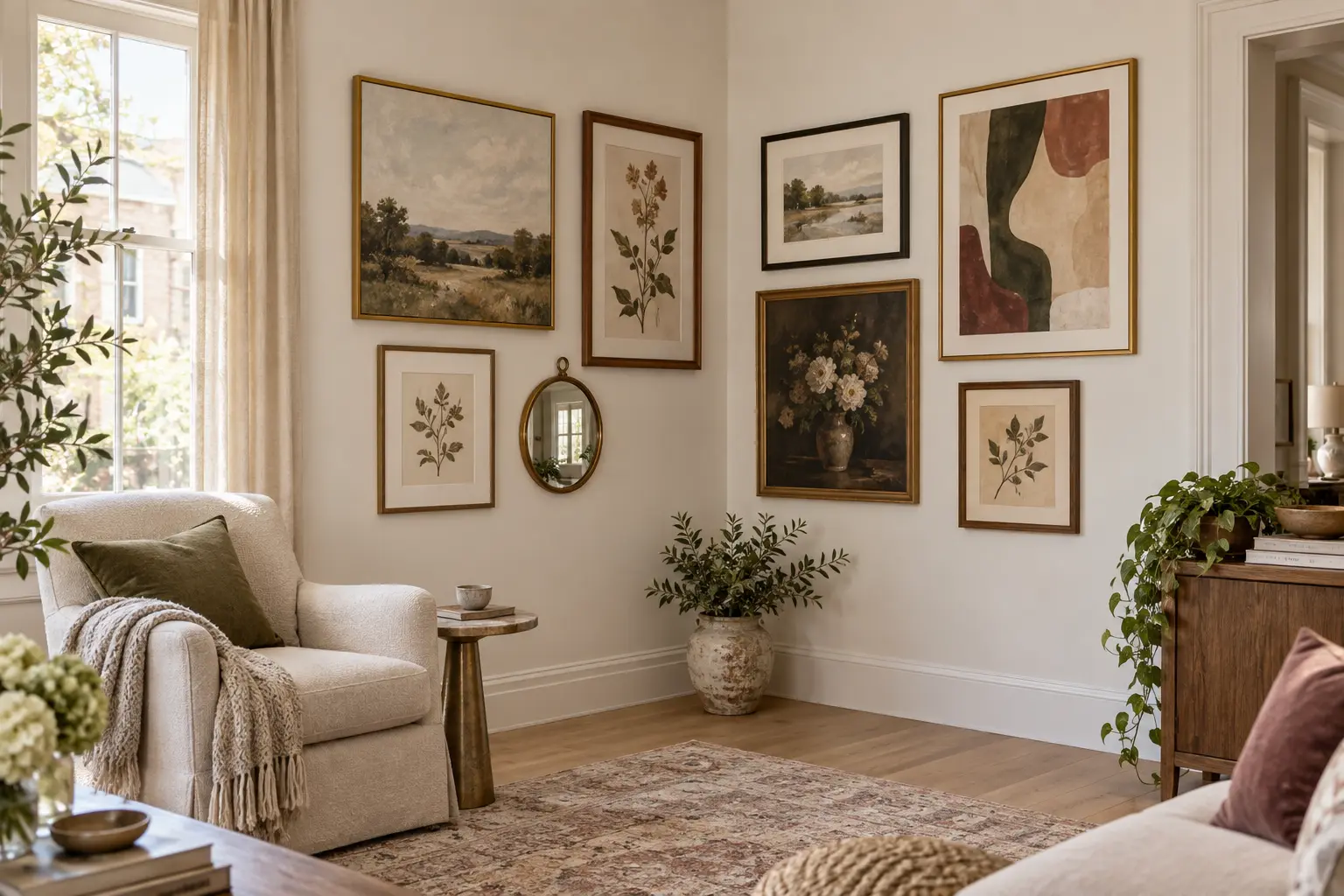
A corner gallery wall solves that problem by treating two walls as one display. It can define a reading nook, soften a narrow hallway or give an overlooked dining corner a reason to exist. The difficult part is not finding art. It is working out where the arrangement should begin, how it should turn the corner and when to stop adding frames.
The good news? You do not need fifteen matching prints or a designer’s measuring kit. For most rooms, five to seven well-placed pieces are enough. Put the largest piece on the wider wall, carry two or three smaller pieces onto the adjoining wall and repeat one color, material or subject across the display. That simple formula looks considered without feeling stiff.
These corner wall gallery ideas include exact layout starting points, renter-friendly choices and ways to make the display feel personal without inventing a theme your home never had.
Which of These Corner Wall Gallery Ideas Suits Your Space?
Use this quick guide before buying a single frame.
| If your corner is… | Start with… | Best number of pieces |
|---|---|---|
| Small or narrow | A five-frame wrap | 5-7 |
| In a rental | Lightweight frames or a picture ledge | 3-6 |
| Tall and empty | A vertical salon layout | 7-12 |
| Dark | A mirror-and-art mix | 4-7 |
| Modern or minimal | An L-shaped grid | 4-8 |
| In a family room | A photo or children’s art display | 6-10 |
| Full of sentimental objects | A memento wall | As it grows |
If you are undecided, choose the five-frame wrap. It is the gallery-wall equivalent of a good white shirt: simple, useful and very difficult to regret.
How to Plan a Corner Wall Gallery Before Hanging Anything
Measure the usable width of both walls, not the entire walls. Doors, switches, furniture and radiators all count as boundaries. Then arrange your frames on the floor inside those measurements.
Keep roughly 2-3 inches (5-8 cm) between neighboring frames. Near the corner seam, leaving 2–4 inches (5–10 cm) between a frame edge and the corner usually gives the arrangement enough breathing room. Treat those numbers as starting points, then adjust for chunky or unusually shaped frames.
Next, trace every frame onto plain paper, cut out the shapes and tape them to the wall. Stand in the doorway, sit in the chair below the display and look from both sides of the room. A layout can behave beautifully on the floor and become strangely top-heavy on the wall. Paper templates expose that problem before the hammer does.
One more rule: balance visual weight, not frame count. A large dark frame on one wall may need three light pieces on the other wall to feel balanced. Two frames on each side are not automatically equal.
13 Corner Wall Gallery Ideas That Feel Personal, Not Overdone
1. Start With a Five-Frame Wrap
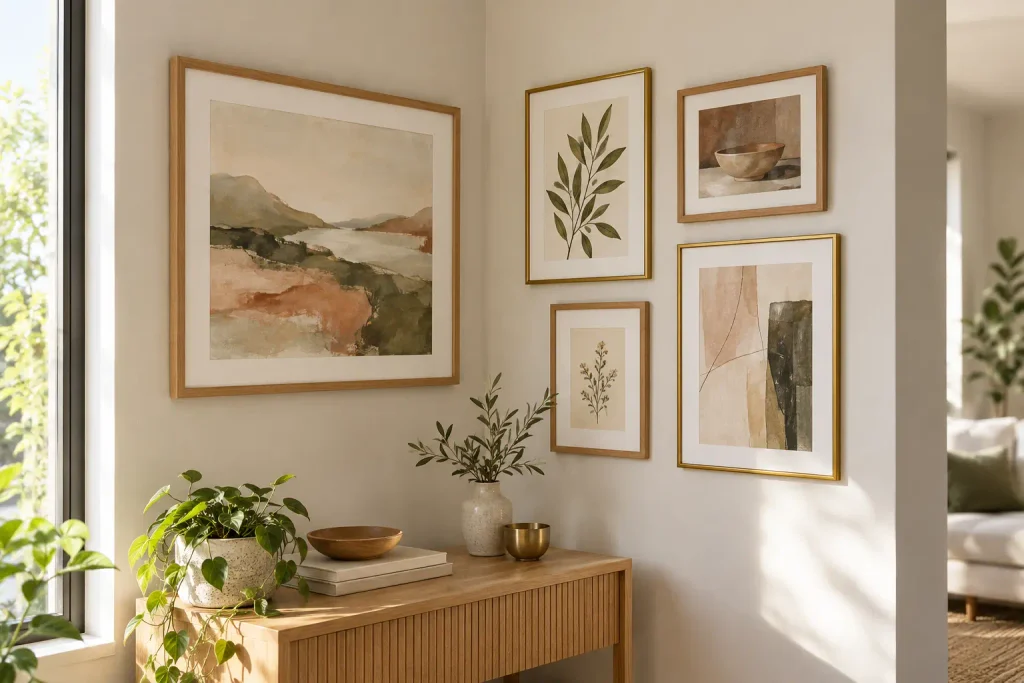
Of all the corner wall gallery ideas in this guide, this is the safest first attempt and the layout most likely to suit an average living room, bedroom or entryway.
Place one medium-to-large anchor frame on the wider wall at roughly eye level. Add two smaller pieces above and below it, then continue the same rhythm with two pieces on the adjoining wall. The frames do not need to mirror one another; they only need to feel connected.
A useful starter mix is one 16 x 20-inch frame (about 40 x 50 cm), two 11 x 14-inch frames (about 28 x 36 cm) and two 8 x 10-inch frames (about 20 x 25 cm). Repeat the same frame finish at least twice on each wall so the corner reads as one composition rather than two unrelated clusters.
Honestly, five frames with a plan beat fifteen bought in a panic.
2. Build a Collected-Over-Time Memento Corner
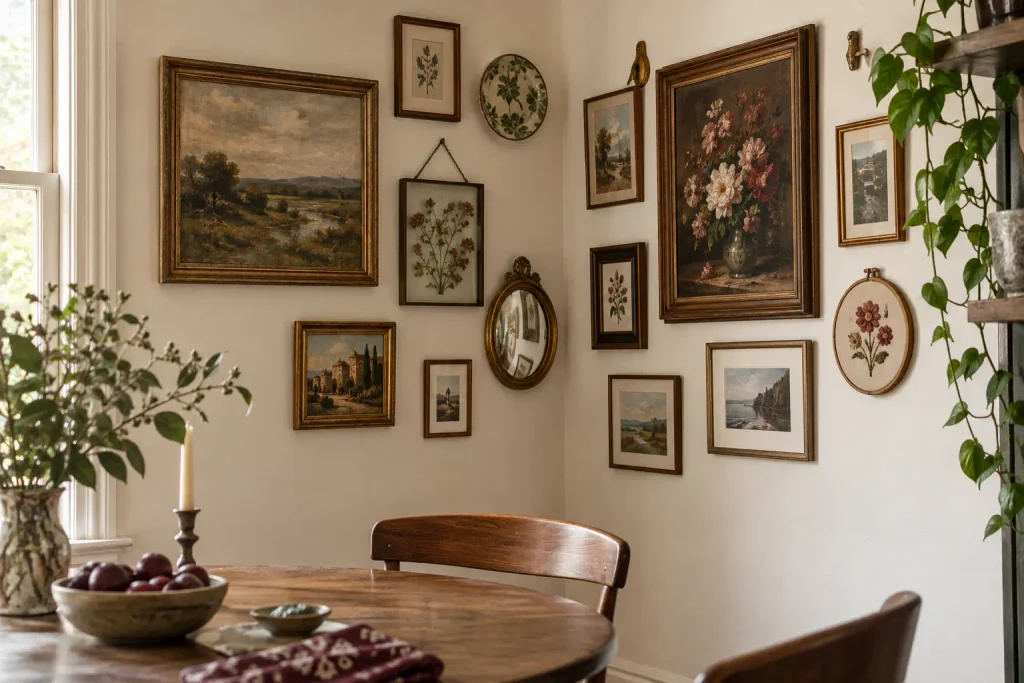
The freshest gallery walls in 2026 are moving away from identical print sets and toward displays that feel gathered rather than ordered. Current coverage of the “Everyday Exhibits” look highlights a relaxed mix of artwork, ceramics, textiles and vintage mirrors instead of perfectly matched frames.
For a corner version, begin with one meaningful item on each wall: perhaps a framed postcard, a family photograph, a small embroidery or a handwritten recipe. Add a quiet landscape or line drawing between busier pieces. That pause matters. When every object shouts, the corner sounds like a group chat with twelve people typing at once.
The display does not need to be finished this weekend. Leave a deliberate gap for something you have not found yet. A wall that grows slowly will feel more convincing than a “personal” collection ordered as a complete set on Tuesday night.
3. Use an L-Shaped Grid for a Calm, Modern Look
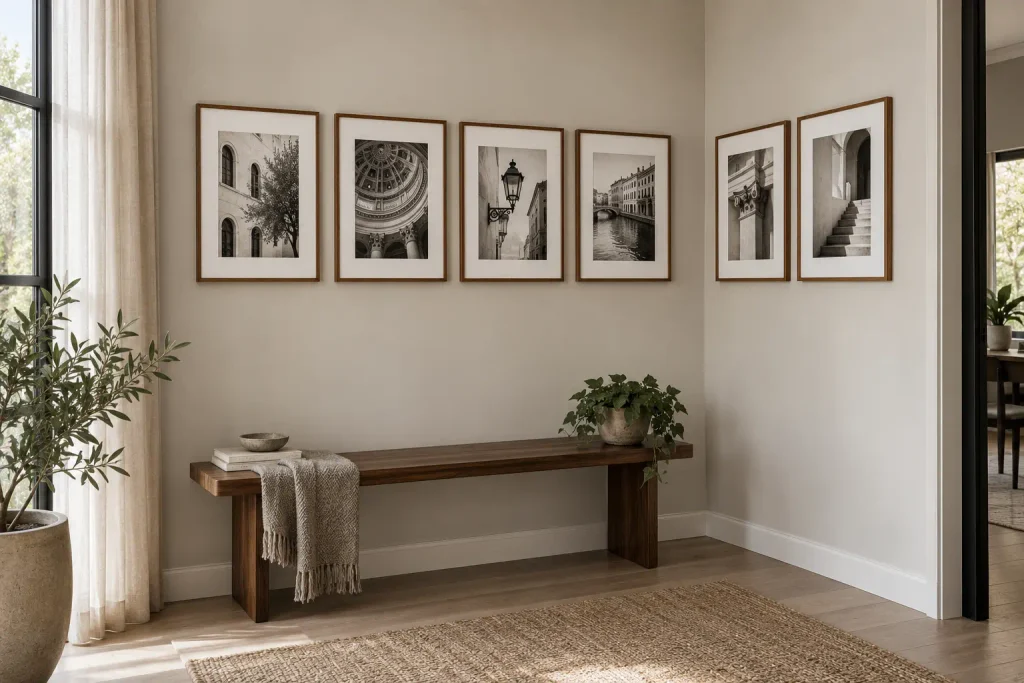
If mismatched frames make you itchy, choose a grid. Use four, six or eight frames of the same size and carry the rows around the corner in an L shape.
Keep the top line level across both walls and use the same 2–3-inch gap throughout. A six-frame version could place four frames on the wider wall and two on the narrow one. Equal numbers are unnecessary; consistent spacing is what creates order.
Black-and-white photographs, simple architectural prints or a botanical series work well here. Buy all the matching frames at once, including one spare if possible. Finding the same frame six months later is a tiny domestic quest nobody needs.
4. Make a Renter-Friendly Mini Gallery
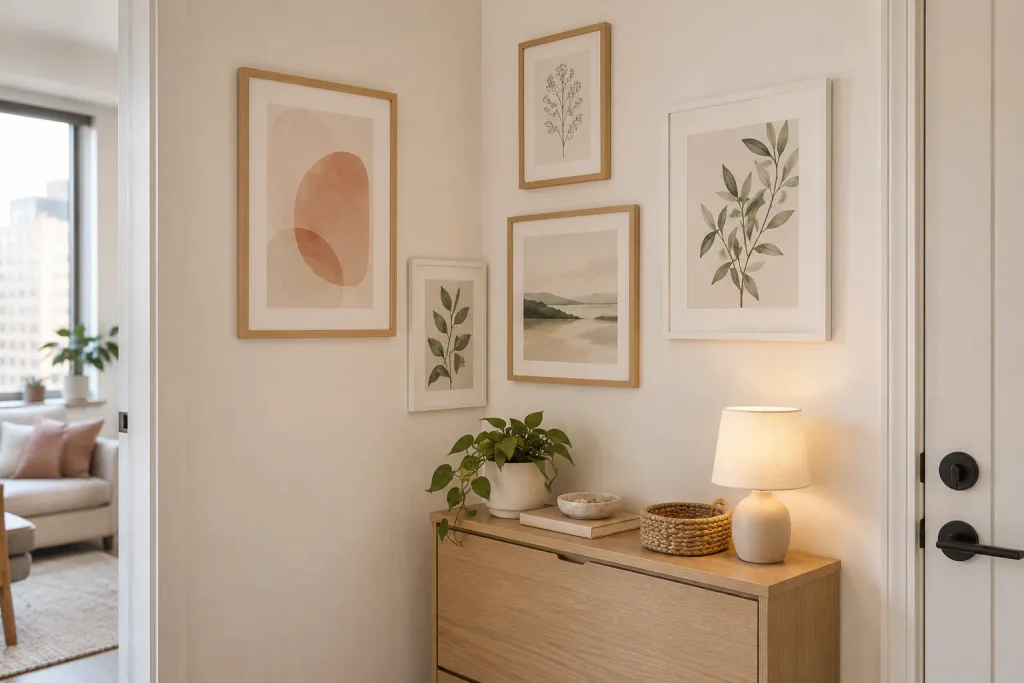
Some corner wall gallery ideas assume you own the room. This one does not. A rental does not mean the corner has to remain blank, but “damage-free” should never mean “ignore the instructions.” Use lightweight frames and choose a hanging product rated for each frame’s actual weight and wall surface. Clean and prepare the wall exactly as the manufacturer directs, and check your tenancy or lease before making permanent changes.
The official Command picture-hanging instructions say to wait seven days after painting, avoid wallpaper and not hang valuable or irreplaceable items with the strips. They also specify a waiting period before rehanging the frame. Those details are less exciting than styling, but they are considerably more exciting than hearing a frame fall at 2 a.m.
For a simple renter-friendly gallery wall, use three to five acrylic-front frames rather than heavy glass. Arrange them as a loose vertical cluster, or use removable photo tiles made for compatible painted surfaces. Test one discreet area first, especially if the paint is old or flaky.
For more non-permanent ideas, see these apartment decor ideas for rental spaces.
5. Mix Art With One Small Mirror
A mirror is useful in a corner that receives little natural light because it reflects the room instead of adding another visually solid block.
Use one round or softly shaped mirror as the anchor, then surround it with three to six framed pieces. Place the mirror slightly off-center so the arrangement does not resemble a clock face. Repeat its finish elsewhere an aged brass mirror can echo two slim brass frames, while black trim works with a modern monochrome set.
Keep the reflected view in mind. A mirror facing a window, lamp or attractive shelf earns its place. One reflecting the top of a laundry basket is technically functional, but perhaps not the mood.
6. Create a Botanical Reading-Nook Corner
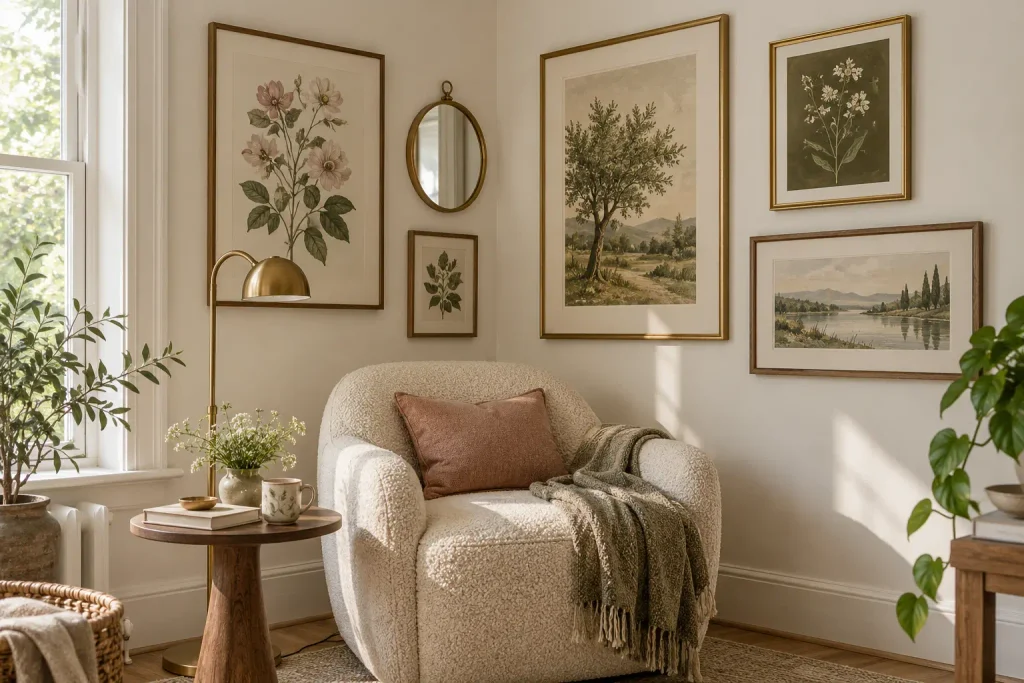
Nature-led corner wall gallery ideas work beautifully in quiet spaces because botanical art adds color without making a room feel noisy. Choose three to seven related images ferns, wildflowers, seed studies or garden sketches and mix one or two sizes.
Natural oak, walnut or slim antique-brass frames suit warm, cozy rooms. Black frames make older illustrations feel cleaner and more contemporary. Pair the gallery with a reading chair and floor lamp, but keep the artwork far enough from the lamp that heat and cords are not an issue.
You do not have to download questionable artwork from a random image search. The National Gallery of Art’s Open Access collection offers thousands of images that are free to download and use. Always check the rights information on the exact image you choose.
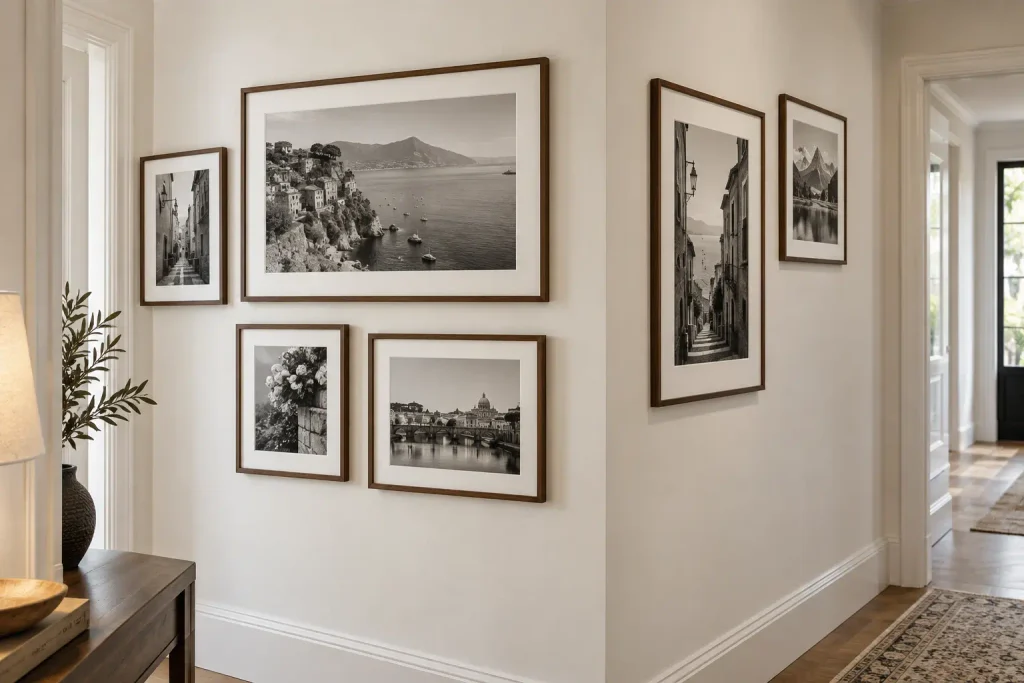
7. Tell One Story With Black-and-White Photos
Family and travel photographs can look polished without becoming formal. Convert the selected images to black and white, use matching mats and allow the frame sizes to vary.
Choose photographs that create a rhythm: one wide scene, one close portrait, one small detail and a few quieter images. A set made entirely of close-up faces can feel crowded, particularly in a narrow hallway. The wider shots give the eye somewhere to rest.
Wrap the timeline around the corner rather than arranging it rigidly by date. The best photo walls invite a closer look; they do not need to behave like a family spreadsheet.
8. Try the 2026 Mixed-Media “Everyday Exhibit” Look
This is the bolder cousin of the memento wall and one of the most current corner wall gallery ideas for 2026. Combine framed art with a small plate, shallow basket, textile piece or sculptural object. The variation creates depth and makes the display feel less like a packet of coordinated prints.
On a small corner, limit the arrangement to one or two three-dimensional pieces. Keep at least one thread consistent: a repeated color, similar warm metals or a nature theme. If the materials, colors and subjects are all different, the display loses its plot.
Use proper fixings made for each object. A decorative plate hanger is designed for a plate; a picture strip is not automatically its substitute. Avoid placing heavy or breakable objects above beds, cots, sofas or seats.
9. Frame Children’s Art Without Making It Feel Like a Noticeboard
Children’s artwork already has color, personality and a much better backstory than generic wall quotes. The trick is giving it a little structure.
Choose six to eight pieces with different scales. Place them in simple white, pale wood or colored frames, then use matching mats to calm the mix. Frames that open from the front make rotation easier, while clip frames suit lightweight work in a playroom or family workspace.
Let the display stay slightly imperfect. A tiny handprint beside a wonderfully serious dinosaur is not a styling problem. It is the entire point.
Mount anything with small parts or glass out of young children’s reach, and secure heavier frames with appropriate wall fixings.
10. Use One Oversized Anchor and Three Smaller Pieces
This layout gives a corner the confidence of a large artwork without requiring both walls to be filled.
Hang one oversized piece on the main wall, then place three smaller works on the adjacent wall. Align the middle of the small cluster with the visual center of the anchor rather than matching their top edges. The result feels balanced but not overly engineered.
Choose the anchor first. Pull two colors from it for the smaller art and frames. This could be a large abstract paired with small line drawings, a landscape with two photographs and a textile, or a bold photograph with quieter tonal prints.
This idea is especially useful beside a dining banquette, reading chair or compact desk where a floor-to-ceiling gallery would feel too busy.
11. Turn a Breakfast Corner Into a Tiny Art Café
Kitchen and breakfast-nook corners suit artwork with a little wit: vintage fruit labels, café sketches, handwritten family recipes or food photography. Add one small ceramic plate if the wall can support it safely.
Avoid precious paper, unsealed textiles and delicate originals near steam, grease, a hob or sink. Use protected prints and wipeable frame fronts, and keep the arrangement away from splash zones. A kitchen gallery should survive the kitchen; otherwise it is just an expensive hostage situation.
Start with one larger food or landscape print, then carry two small recipe or postcard-sized pieces around the corner. The limited scale keeps the nook warm without making it feel themed.
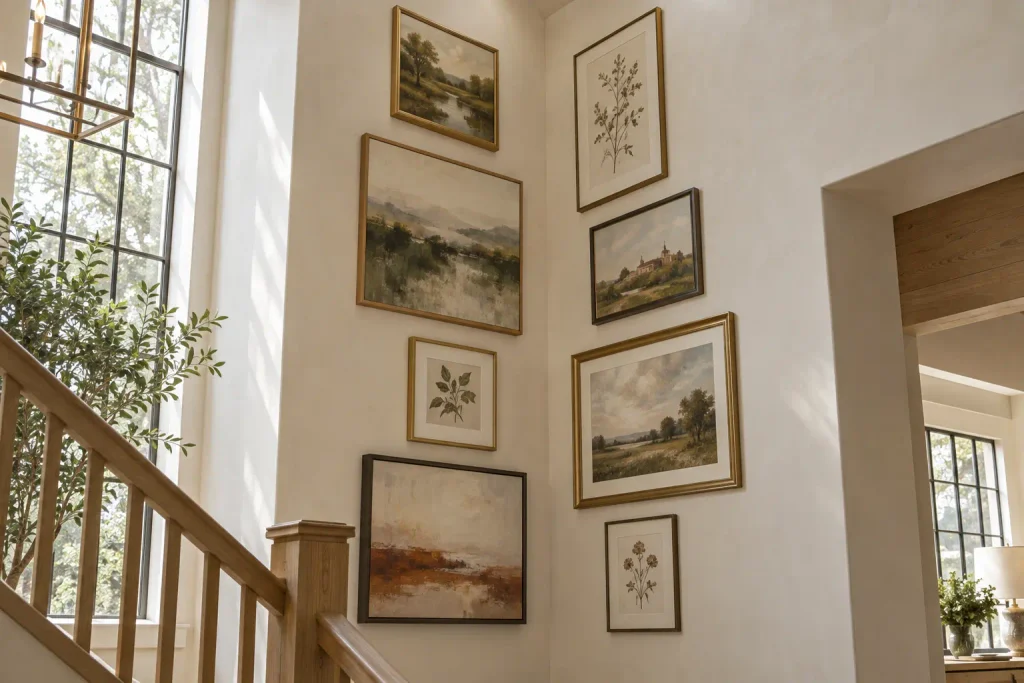
12. Run a Vertical Gallery Up a Tall Corner
A narrow corner with high ceilings needs height more than width. Stack five to nine frames in a loose vertical column, using the corner seam as the arrangement’s spine.
Begin near normal eye level and work upward. Alternate portrait and landscape pieces, but keep the outer boundary reasonably narrow. One frame can break the edge slightly; five frames breaking it looks accidental.
This treatment works well in stair landings, double-height entryways and the slim wall beside a bookcase. For anything hung above reachable height, use suitable permanent fixings and a stable ladder or hire someone equipped to do it safely. A Pinterest save is not worth a wobbly-chair adventure.
13. Design a Gallery That Can Change With the Seasons
Seasonal rotation works best when the frame layout stays fixed and only the contents change. Choose frames with easy-access backs, then keep replacement prints in labeled folders so swaps take minutes, not an entire afternoon.
You do not need to replace everything. Change two or three pieces: muted botanicals in spring, travel photographs in summer, warmer landscapes in autumn and a restrained festive print in winter. Leaving part of the display unchanged prevents it from looking like a shop window.
This is also a smart budget strategy. Spend on frames once, then use your own photographs, children’s artwork and legally reusable art for inexpensive updates. The same “edit first, buy second” approach appears throughout these budget home decor ideas.
The Corner Gallery Wall Formula That Rarely Fails
If thirteen corner wall gallery ideas have created more decisions than you wanted, use this exact recipe:
- One anchor frame on the wider wall
- Two medium pieces, one on each wall
- Two smaller pieces to fill the upper and lower gaps
- A repeated frame finish on both sides
- One personal item, such as a photograph, postcard or small artwork
- Roughly 2-3 inches (5-8 cm) between neighboring pieces
- Paper templates before any nails or adhesive strips
Start with five pieces. Live with them for a week. Add more only if the corner still looks unfinished. Empty wall around a gallery is not wasted space; it is what lets the art breathe.
Common Corner Gallery Wall Mistakes
Starting Too High
People often hang the first frame high, then every new frame climbs closer to the ceiling. Position the visual center of the whole arrangement around seated or standing eye level for the room. Above furniture, relate the gallery to the furniture rather than to the ceiling.
Making Both Walls Identical
A corner is rarely symmetrical, so forcing equal frame counts onto unequal walls can look stiff. Let the wider wall carry more visual weight.
Using Only Tiny Frames
Small frames are charming up close but can look like confetti from across a room. Include at least one substantial anchor piece unless the gallery occupies a deliberately tiny nook.
Mixing Everything Without a Common Thread
Eclectic does not mean random. Repeat one element color, frame material, mat style or subject to hold the mix together.
Hanging First and Planning Later
Paper templates may feel fussy for ten minutes. Filling six unwanted holes feels fussy for considerably longer.
Choosing Art You Do Not Care About
The current collected look works because it carries a story. Use your photographs, original work, licensed prints, public-domain art or objects you genuinely want to see. Do not tear pages from books or reproduce artwork unless you own the item and have the right to display or copy it.
Frequently Asked Questions
How many pictures should go on a corner gallery wall?
Most corner wall gallery ideas work with five to seven pieces in a small or medium space. Three can create a minimalist display, while a tall salon-style corner may use nine or more. The available wall area and frame sizes matter more than a fixed number.
Should both sides of a corner gallery wall match?
They should connect, not necessarily match. Repeat a color, frame finish, mat style or subject on both walls. Let the wider wall hold the larger piece or the larger share of the display.
What spacing looks best between gallery wall frames?
Start with about 2-3 inches (5-8 cm) between neighboring frames. Keep the gaps visually consistent, then make small adjustments for round, ornate or extra-thick pieces.
How close should frames be to the corner seam?
A starting distance of 2-4 inches (5-10 cm) usually prevents frames from feeling cramped while keeping the two walls connected. Larger frames may need more room.
Can renters create a corner gallery wall without nails?
Yes, with lightweight frames and removable hanging products that suit the frame weight and wall surface. Follow the product instructions, check the lease and test a discreet patch. Adhesive products are not appropriate for every paint finish or wallpaper.
Can I mix different frame colors?
Yes. Two or three finishes often look more collected than one. Repeat each finish at least once and keep another element such as the mats or color palette consistent.
Where can I find legal artwork to print?
Use your own photographs, purchase printable art with the appropriate license or search museum open-access collections. Check the rights notice for each image rather than assuming everything found online is free to reproduce.
Final Thoughts
The best corner wall gallery ideas do more than fill a blank patch. They make two disconnected walls feel like one intentional part of the room.
Begin with the five-frame wrap if you want an easy answer. Choose an L-shaped grid if order makes you happy, or build a memento corner slowly if you want the display to carry a real story. There is no prize for using the most frames. The goal is to make the corner worth looking at and to stop before it looks as though the frame shop lost a fight.
Save this guide to your Pinterest wall-decor board, then photograph your paper-template layout before hanging the first piece. That one photo will save you more second-guessing than any measuring trick.