
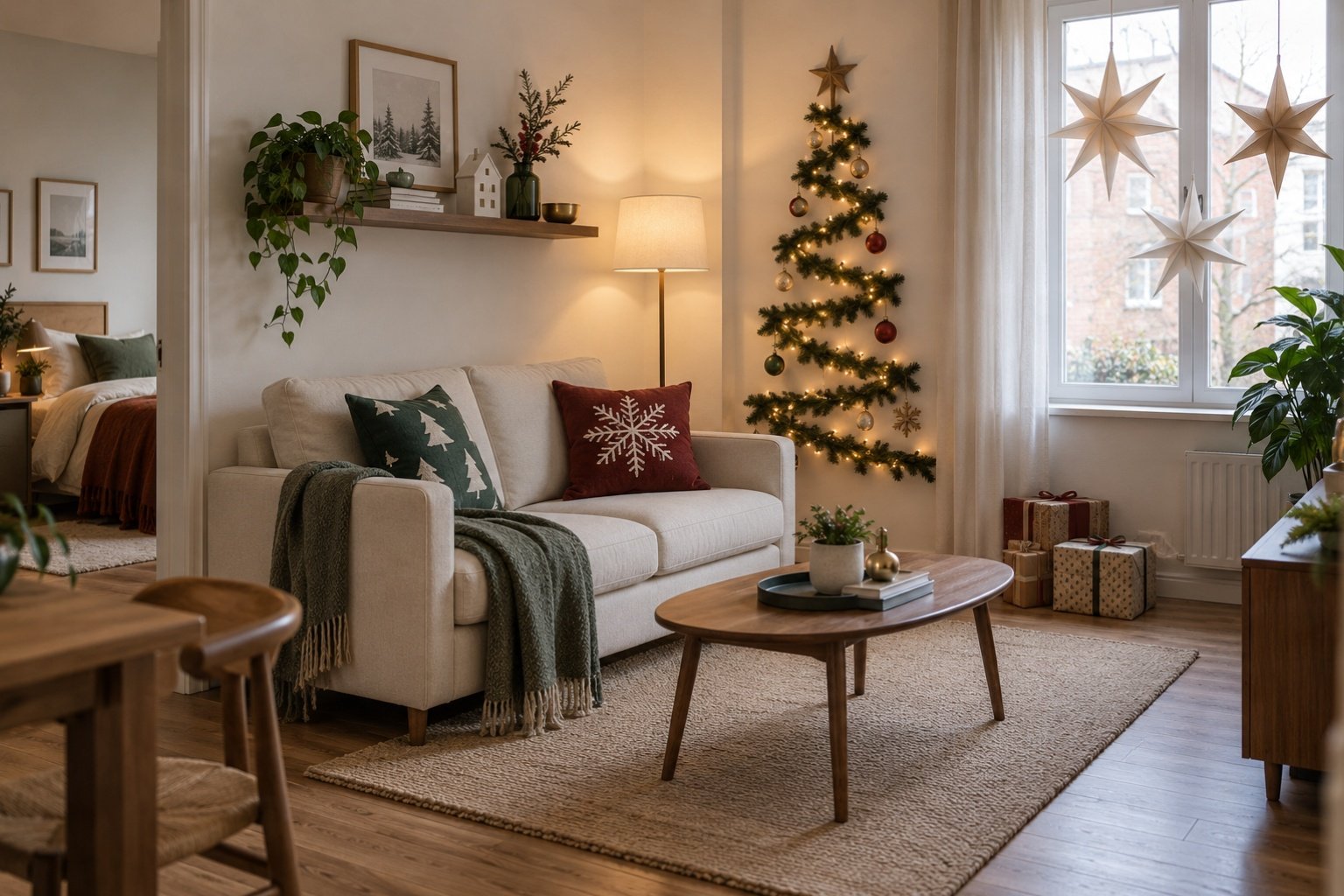
Small Apartment Christmas Decor: 3 Smart One-Box Plans
Small apartment Christmas decor has one brutally honest reviewer: January.
December forgives the extra cushions, floor lanterns and oversized boxes arranged beneath a tree. January wants to know where all of it will live for the next eleven months.
That is why this guide starts with a storage box, not a shopping basket.
Each of the three plans below creates a complete Christmas look using walls, windows, textiles and objects already in the home. When the season ends, the decorative pieces should fit inside one container. No garage is assumed. No spare loft is required. Your apartment should still feel comfortable when the photographs are over and an ordinary Monday begins.
Planning in September is not too early, either. Pinterest reports that holiday activity starts rising as early as September, while people are still comparing ideas and forming their Christmas plans.
So measure the room, choose the box and ignore any decoration that expects your hallway to become its permanent home.
The One-Box Rule
Choose your storage limit before choosing a colour palette.
The box might slide beneath the bed, sit on a high wardrobe shelf or share space with your existing linens. Measure that location first. A container that looks compact in a shop can become surprisingly large when it has nowhere to go.
The rule is simple:
Everything purchased only for Christmas must fit inside that box.
Objects used throughout the year do not count. An existing serving tray, neutral throw, glass vase or tension rod can join the display without becoming seasonal clutter later.
Items that collapse, fold or get used up are particularly valuable:
- Cushion covers instead of complete cushions
- Fabric ribbon instead of plastic signs
- Paper stars and houses instead of bulky figurines
- A short light set instead of several tangled strands
- Coordinated wrapping paper instead of decorative empty boxes
- Stockings that fold flat
- Shatter-resistant ornaments stored inside one another
This is not minimalist Christmas for the sake of having less. It is a practical limit that forces every piece to contribute something visible.
If an item needs half the box but barely changes the room, it has failed the audition.
Take a Six-Minute Look at the Room
Before deciding which plan suits your apartment, check three things.
The route
Walk from the entrance to the sofa and then into the kitchen while carrying a laundry basket or two shopping bags. That is the space your Christmas decorations cannot steal.
Floor decor often looks harmless until someone has to walk past it every day. A slim tree may technically fit beside the sofa while still catching sleeves, blocking a cupboard or turning the route to the kitchen into a slalom course.
Protect the route first.
The anchor
Find the first place your eye lands when you enter the room. It may be a window, the wall above the sofa, a bookcase or a small dining table.
That becomes the Christmas anchor.
You do not need festive details in every corner when one area creates a clear mood. In fact, a single finished scene normally makes a small apartment feel calmer and more intentional than decorations scattered across every available surface.
The reality
Check the lease before attaching anything to walls, windows or doors. Look at the condition of the paint and test removable products in a hidden area.
“Renter-friendly” should mean low risk and reversible. It does not mean that every adhesive will leave every painted surface untouched.
For more permanent everyday improvements, these apartment decor ideas focus on changes that do not require a full renovation.
Now choose the plan that matches your actual room.
Plan One: The Window Christmas
Best for: Studio apartments, rented flats and rooms with no free floor space
What it changes: One window and the area immediately around it
January footprint: A flat folder and one small bag
This is the lightest plan physically and visually.
Begin with three fold-flat paper stars: one large and two smaller. Hang them from an existing curtain rod at slightly different heights, keeping them clear of blind cords and the opening mechanism.
Do not centre everything perfectly. Place the largest star slightly to one side and let the smaller pair balance it. The window will feel styled without resembling a shop display.
Add a short strand of warm-white lights around the inside edge of the window. A timer is useful, but the controls and battery compartment must remain easy to reach.
The lower half of the display can stay almost empty. Daylight is part of the design, and covering the entire pane with decorations makes a small room feel closed in.
If the glass still needs something, use a restrained group of static-cling snowflakes or washable window designs in two corners. Ten carefully spaced snowflakes look deliberate. Fifty usually look like weather.
Finish the scene with one existing chair or side table near the window. Add a folded throw and a single cushion cover in the chosen colour. Nothing else is required.
The whole plan consists of:
- Three paper stars
- One short warm-white light set
- A few removable window details
- One cushion cover or throw already owned
- Optional fabric ribbon
Paper stars close flat. Window clings return to their backing sheet. Ribbon folds into the light bag.
The window becomes the decoration, so the apartment does not have to surrender any floor space.
Plan Two: The Sofa-and-Shelf Christmas
Best for: Small living rooms that need warmth rather than a traditional tree
What it changes: The sofa and one shelf
January footprint: One half-full storage box
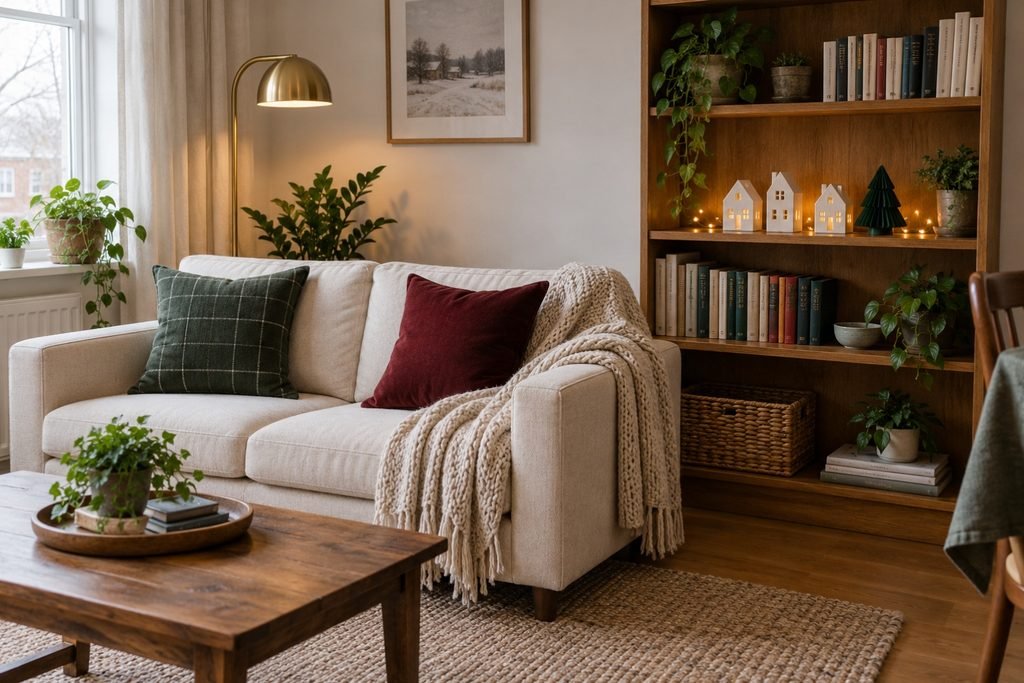
This plan works by replacing everyday details instead of adding Christmas objects on top of them.
Start with the sofa. Keep the existing cushion inserts and change only two covers. Use one subtle pattern and one solid texture: perhaps a dark green check beside burgundy velvet, or a cream stripe next to warm brown boucle.
They do not both need Christmas trees printed across them. The room will feel festive because the colours, texture and light have shifted not because every object announces the date.
Fold a familiar throw over one arm of the sofa rather than spreading it perfectly across the back. A room feels more welcoming when it appears ready to be used.
Next, choose one shelf.
Remove three everyday objects before introducing anything seasonal. This small step prevents the usual December problem: Christmas decor balanced in front of books, family photographs and items that were already competing for space.
Build a simple scene with:
- Two or three fold-flat paper houses
- One small paper tree
- Two battery-operated tea lights
- A framed Christmas card or miniature print
- Visible empty space
Place the lights behind the paper houses so the windows glow. Avoid lining every piece up at the front edge. One object can sit forward while another disappears slightly into the background.
If there is an existing picture frame above the shelf, wrap fabric ribbon around it like a present. Secure the ribbon at the back of the frame instead of attaching it to the visible finish.
Stop there.
The sofa carries the colour. The shelf provides the detail. Warm light connects the two.
When Christmas ends, the cushion covers fold around the paper pieces, the tea lights sit together and the ribbon rolls into the remaining gap. No seasonal cushion inserts are left occupying a cupboard until next winter.
Plan Three: Christmas Without a Floor Tree
Best for: Apartments that want a recognisable Christmas focal point but cannot accommodate a traditional tree
What it changes: One wall, one tray and the gifts you already plan to give
January footprint: One compact box
Do not let an idealised Christmas photograph convince you that every home needs a six-foot tree.
A tree is one way to create height, lights and a place for ornaments. Those three jobs can be handled without placing a large object in the middle of the room.
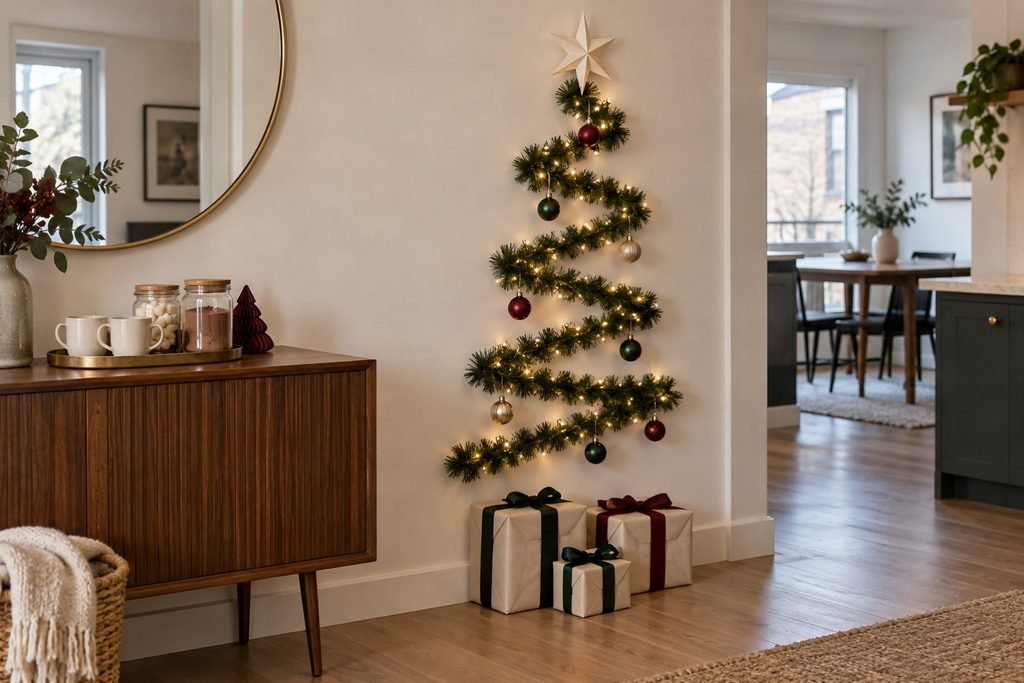
Create a narrow tree shape on a blank wall using lightweight faux garland or wide fabric ribbon. Begin near eye level and work down in a loose zigzag, widening gradually towards the bottom.
The finished shape does not need to touch the floor. Leaving space beneath it makes the display feel lighter and provides room for real gifts later.
Add eight to twelve lightweight ornaments. That is enough to make the shape readable without forcing every ornament you own onto the wall. A paper star or structured bow can finish the top.
Use attachments rated for the wall surface and decoration weight. Follow the manufacturer’s instructions and test one in a hidden area. Recently painted, weak or textured walls may not respond well even to products marketed as removable.
If you already have a gallery arrangement nearby, avoid creating another busy cluster. These corner wall gallery layouts show how spacing affects the whole wall.
Now add a small practical scene beneath or beside the wall tree.
Place an existing tray on a console, kitchen counter or side table. Use it for two mugs, sealed tea or hot-chocolate ingredients, a spoon jar and one small paper decoration. It creates a Christmas drinks station without asking the room to accommodate a dedicated bar cart.
Finally, let the real presents complete the display. Choose two coordinating wrapping papers and one ribbon. Cream with dark green feels calm. Brown paper with burgundy ribbon feels warmer. A repeated palette makes parcels look intentional even when every shape is different.
There is no need to manufacture a pile of empty boxes for the photograph. Real gifts arrive gradually, look better and eventually leave the apartment.
After Christmas, the garland coils into the box, lightweight ornaments sit inside a small protective container and the ribbon folds beside them. The tray and mugs return to ordinary use.
The tree disappears. The floor was never occupied.
Make the Colours Belong to the Apartment
Christmas colours should work with the room instead of fighting it.
If the apartment already contains warm wood, cream fabric and brass details, forcing icy silver and bright blue into every corner will require more decorations to make the scheme feel convincing.
Borrow the palette from what is already there.
Warm and familiar
Use forest green, deep red and warm white. Keep the red closer to oxblood or burgundy than bright scarlet if you want the room to feel quieter.
Soft and current
Pair chocolate brown with butter yellow, cream and a small amount of brass. It feels festive without depending on obvious Christmas motifs.
Vintage after dark
Combine burgundy, deep indigo and aged gold. Use the darker shades through ribbon and textiles, allowing paper stars or warm lights to provide contrast.
Whichever palette you choose, repeat it through materials rather than buying a separate object in every colour.
Green ribbon, a green cushion cover and green wrapping paper create a connection. Three unrelated green ornaments rarely do.
The room should look as if Christmas arrived in your home not as if your home was temporarily replaced by Christmas.
Build the Storage Box While You Decorate
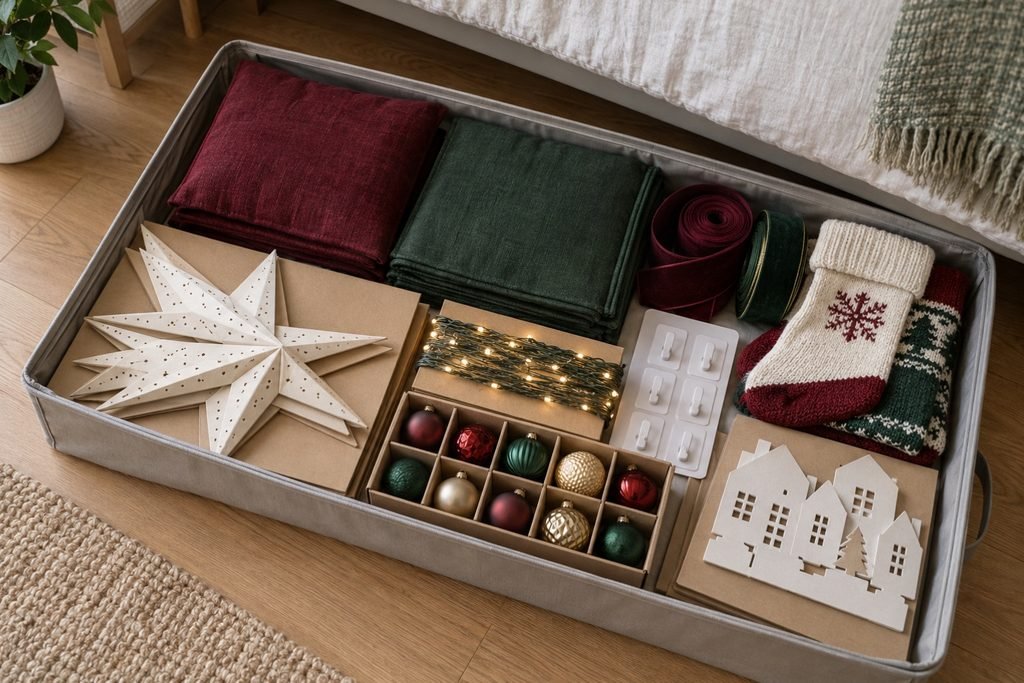
Keep the empty storage box nearby during setup.
Packaging, spare hooks, instruction sheets and unused ornaments go directly inside it. This immediately shows how much space remains and prevents small components from disappearing into random drawers.
Use the base for folded textiles and stockings. Place paper stars and houses between two pieces of cardboard. Wind the light strand loosely around a rectangular piece of card rather than dropping it into a knot.
Lightweight ornaments can sit inside a shoebox within the main container. Put delicate paper pieces on top.
Add a simple label listing what belongs inside. Next January, the list makes it obvious whether something is missing. Next December, it prevents buying duplicates because you forgot what you already owned.
If the container cannot close without being forced, the display has exceeded its limit.
Remove the least useful piece now. January should not be responsible for editing December’s decisions.
The same principle can be used throughout the home; these home organization ideas focus on systems that are easier to maintain than occasional large clean-outs.
Give the Setup One Weekend, Not the Entire Month
Christmas decorating can quietly become a collection of unfinished mini-projects. A short schedule keeps it enjoyable.
Friday evening: Decide
Choose the focal point, palette and one of the three plans. Measure the wall, window or shelf. Check the storage box and write a short list of what is genuinely missing.
Do not start browsing products until this part is finished.
Saturday morning: Shop the home
Look through cushion covers, trays, frames, ribbon, glassware and plain textiles already owned. Several useful pieces may not appear festive until they are grouped with the right colour and light.
Make paper decorations or organise the items that need to be purchased.
Saturday afternoon: Build the anchor
Complete the window, shelf or wall tree first. Do not begin decorating a second room because the first one looks temporarily sparse.
Add the textile and functional details only after the focal point is finished.
Sunday morning: Remove one thing
Photograph the room from the entrance and look at the image for clutter, blocked routes and uneven colour.
Remove the weakest item.
This final edit is usually what separates a comfortable home from a room that merely contains many Christmas decorations.
What Is Not Worth the Storage Space?
Large seasonal items need to work exceptionally hard in a small apartment.
A decorative ladder holds blankets but occupies floor space that an ordinary basket could use more efficiently. Full Christmas cushion inserts provide the same visual result as covers while requiring several times more storage. Floor lanterns look atmospheric until they become something everyone has to avoid.
Be cautious with:
- Oversized freestanding signs
- Decorative empty gift boxes
- Complete seasonal cushion inserts
- Heavy garlands supported only by adhesive hooks
- Floor decorations placed in walking routes
- Glass ornaments at child or pet height
- Christmas furniture with no useful purpose
- Large items that cannot be folded, nested or reused
There is nothing wrong with owning a decoration simply because it brings joy. The test is whether it brings enough joy to deserve its storage space.
That answer will be different in every home. The box simply makes the trade-off visible.
Keep the Glow Safe
Inspect light sets before use. Damaged wires, cracked components and loose connections are reasons to replace a set rather than hide the problem behind garland.
Avoid overloading sockets or joining light sets unless the manufacturer specifically allows it. Keep electrical decorations away from paper, fabric and other materials that can burn.
Electrical Safety First advises switching Christmas lights off and unplugging them before leaving home or going to bed.
For US readers, the Consumer Product Safety Commission recommends using lights tested by a recognised safety laboratory and choosing flameless candles whenever possible.
Make sure decorations do not block doors, vents, radiators, sockets or window access. Secure loose cables away from walking routes. Keep small removable pieces and breakable ornaments beyond the reach of young children and pets.
A warm glow is lovely. An overloaded extension lead hidden beneath paper stars is not.
Can This Plan Work Without Buying Anything?
Very nearly.
Paper snowflakes can be made from plain paper. Existing artwork can be wrapped with leftover ribbon. A neutral throw can become part of the palette. Real gifts provide colour beneath the wall tree, and a familiar tray can become the drinks station.
The only items that may be missing are suitable attachments or a safe light set. Do not improvise unsafe electrical connections or overload adhesive products to avoid a small purchase.
The goal is fewer useful purchases, not no purchases at any cost.
Can a Small Apartment Still Use a Real Tree?
Yes, if the tree leaves a safe walking route, does not block a doorway and has a genuine storage or disposal plan.
A narrow tree may suit some rooms better than a wall display. Measure the widest branches rather than relying only on the height shown on the product listing.
If the room has to lose a chair or block a cupboard to accommodate it, the wall-tree plan will probably work better.
How Can Christmas Decor Look Cosy Without Becoming Cluttered?
Use texture, warm light and repetition.
Two cushion covers in related colours create more impact than six unrelated ornaments. One pool of warm light is more convincing than several small battery items scattered around the room. Repeating the same ribbon across gifts, a frame and a stocking makes the arrangement feel connected.
Most importantly, leave part of the room unchanged.
Empty space is not unfinished space.
Where Should the Christmas Box Be Stored?
Use a dry location that remains accessible but is not needed every day: beneath a bed, above a wardrobe or inside the upper part of a cupboard.
Avoid damp basements, outdoor sheds or areas with extreme temperature changes, particularly when storing electrical lights, batteries, fabric and paper.
Remove batteries from decorations before long-term storage unless the manufacturer instructs otherwise.
The Christmas Home You Can Still Live In
Good small apartment Christmas decor should survive ordinary life.
The door must open. The sofa must remain comfortable. The dining table should still hold dinner, and nobody should have to step around a decorative lantern while carrying hot tea.
Choose one anchor. Let the rest of the room support it quietly. Then pack the entire seasonal layer into the box that set the limit at the beginning.
December gets a home that feels warmer and more special.
January gets its cupboard back.
That seems like a fair arrangement.