
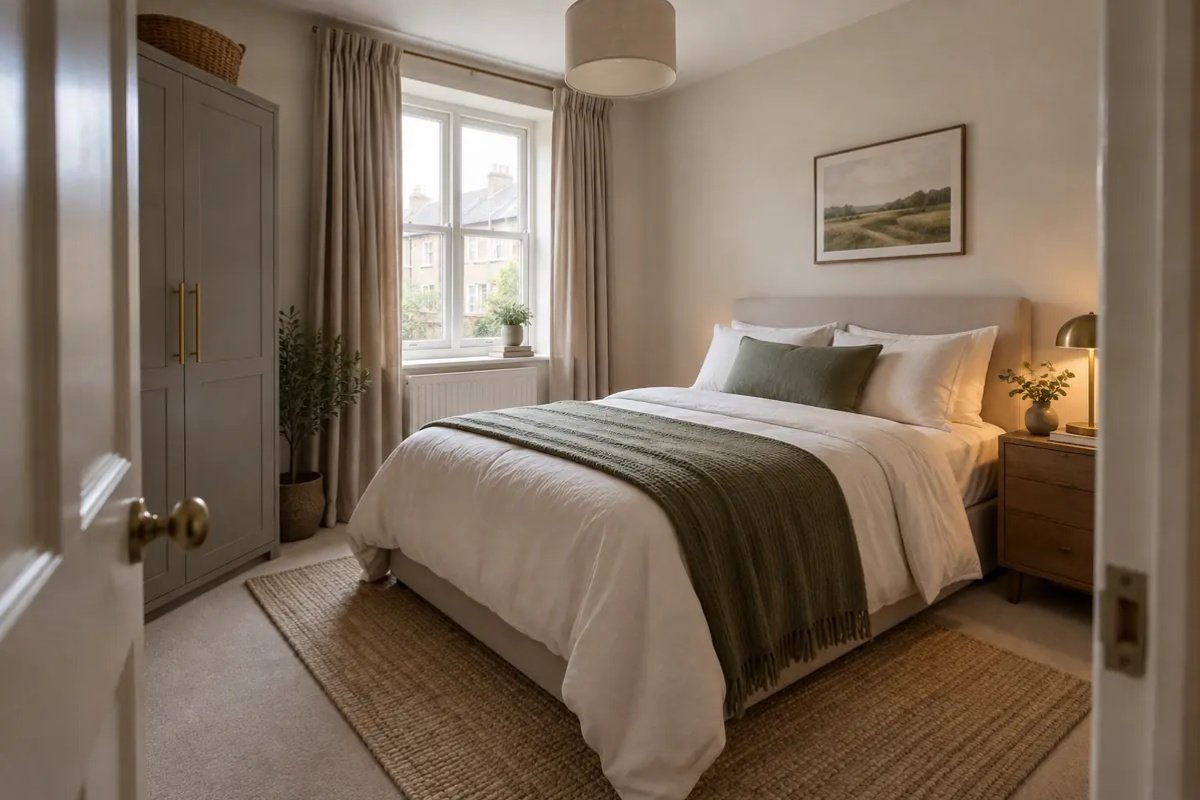
Small Bedroom Ideas That Start With the Way You Actually Live
If you have searched for small bedroom ideas before, you probably know the usual script: add a mirror, choose pale paint, buy furniture with storage and keep everything minimal.
None of that advice is completely wrong. It is simply arriving too early.
A mirror cannot fix a door that catches on a laundry basket. White paint cannot make an overfilled bedside table easier to use. A storage bed will not solve clutter if opening it is so inconvenient that clothes still land on the chair.
So this is not another list asking you to copy ten unrelated rooms. Think of it as a slow walk through your own bedroom. We will begin at the door, follow the route you take every day, notice where things naturally collect and only then decide what deserves to change.
There is no imaginary makeover budget here and no claim that every room needs the same solution. The aim is more honest: make the bedroom feel easier to enter, easier to sleep in and easier to put back together tomorrow.
The Room Usually Explains the Problem Before the Decor Does
Do not tidy before looking at the room. The untidy version contains useful information.
Stand outside the bedroom at the time it normally feels busiest. Open the door fully. Notice what your eye hits first and what your body has to avoid. Perhaps it is the corner of a dresser. Perhaps the bed blocks the most natural route to the wardrobe. Perhaps the first thing visible is not the bed at all, but a chair carrying three days of clothes.
Take a normal photograph from the doorway. Avoid wide-angle mode because it flatters the room and hides the pressure points. The plain photograph is often more revealing than standing inside the space; it turns familiar clutter back into visible clutter.
Now walk the route you actually use. Door to bed. Bed to wardrobe. Wardrobe to mirror. Do any drawers collide? Do you put a bag on the floor because its hook is in an awkward place? Does opening the window require moving something first?
Those interruptions are the real brief. Decorating comes later.
A better question than “How can I fit more in here?” is “What keeps making this room harder to use?”
Walk In Again and Follow the First Line Your Eye Takes
Small bedrooms feel calmer when the eye has somewhere clear to land. That destination might be a neatly dressed bed, a window, one piece of art or simply an uncluttered section of wall.
It does not need to be dramatic. It needs to be more noticeable than the practical mess around it.
Clear the surface nearest the doorway first. Move packaging, spare cables and anything that belongs in another room. If several small decorations are competing for attention, gather the related pieces together and leave space around them. One arrangement reads as a choice; five scattered objects read as unfinished tidying.
Then look at the floor. A laundry basket squeezed behind the door is not hidden if it prevents the door from opening properly. Boxes that project beyond the bed make the route feel narrower every time you pass them. Move the first physical obstruction before moving the largest piece of furniture.
This single change can do more for the sense of space than adding something new. It creates a clean arrival, and the room stops announcing all of its problems at once.
If the bedroom is part of a rental, the wider home may have the same issue: furniture arranged for symmetry rather than daily movement. These apartment decor ideas continue the same flexible, renter-aware approach.
The Bed Is Not Just Furniture; It Is the Floor Plan
The bed usually occupies more space than anything else in the room, yet its position is often inherited rather than questioned. It goes in the center because bedrooms in catalogues have matching tables on both sides. The room then spends years working around that decision.
Who uses the bed matters more than showroom symmetry.
For two people, comfortable access from both sides may be worth protecting even if it means choosing less secondary furniture. For one person, an off-center position can sometimes release a useful strip of floor for dressing, storage or simply moving without turning sideways. A guest room used occasionally can make different compromises from a main bedroom used every night.
Before lifting anything, mark a possible bed position with removable painter’s tape. Walk around the outline. Open the bedroom door, wardrobe and nearby drawers. Check the window, heating, ventilation, outlets and any necessary exit. A layout is not successful if it looks spacious but makes the room less safe or less practical.
Do not move heavy furniture alone, and do not force the bed beneath a window or against a wall simply because an online plan says it saves space. The architecture and the people using the room get the final vote.
The useful question is not “Where should a bed go in a small bedroom?” It is “Which position removes the most repeated frustration?”
That is the part many small bedroom layout ideas miss: a floor plan is only useful when it improves the movements repeated every day.
Sometimes the current position wins. That is still valuable information. It means the bed is not the problem, and you can stop treating it like one.
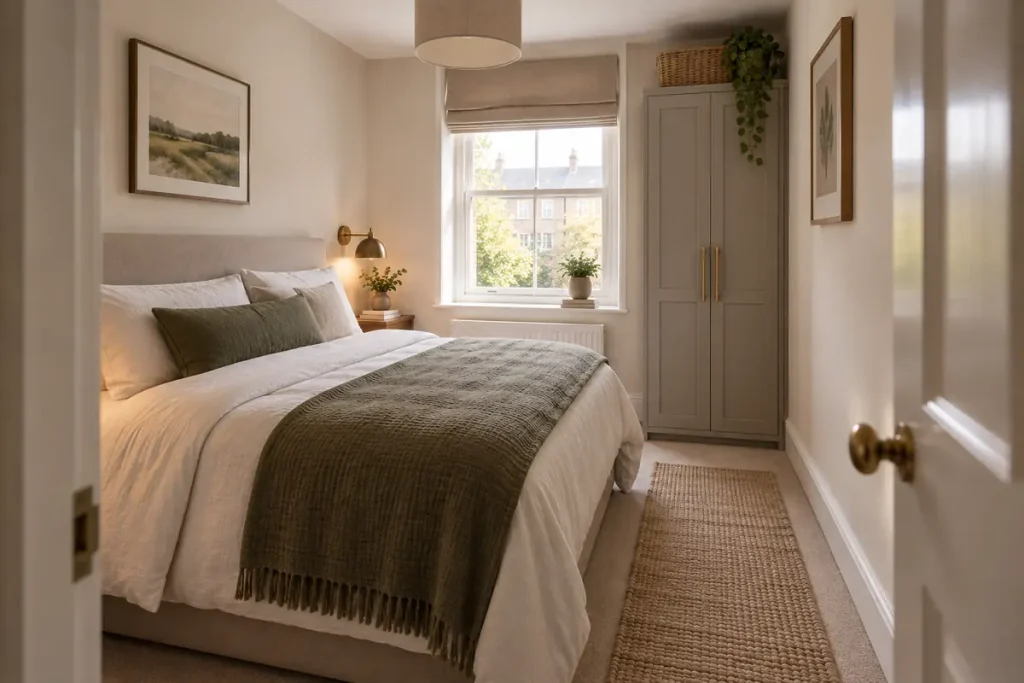
What Has Gathered Beside the Bed?
The bedside area tells a surprisingly accurate story about the room.
A glass of water, reading glasses, medication, a book and a phone charger are not meaningless clutter. They are evidence of what the area needs to do. The problem begins when the same surface is also expected to display decor, store spare toiletries, hold paperwork and catch every item emptied from a pocket.
Instead of searching for the smallest possible nightstand, decide what must be reachable from bed.
If you need hidden storage, a compact drawer unit may earn its footprint better than a delicate open table. If you only need a shallow surface for two or three items, a securely fitted ledge can be enough. Where drilling is unsuitable, a narrow freestanding table or sturdy stool keeps the arrangement flexible. A properly installed wall-mounted, plug-in or clip-on reading light can free the surface that a lamp was using.
There is no need to buy matching bedside furniture if the two sides serve different people or different jobs. Visual balance can come from the lamps, wall color or artwork instead.
Keep the charging cable controlled and away from the walking route. Put genuinely useful items within reach and give everything else a home that does not depend on balancing it beside the pillow.
The result may not look perfectly empty, and it should not. A room designed around a real evening is more valuable than a cleared surface that only exists for a photograph.
Your Clutter Is Following a Route, Even When It Looks Random
Clothes do not appear on a chair by accident. They land there because the chair is easier than the wardrobe, the laundry hamper or the under-bed box.
Watch where the common arrivals stop. Clothes that will be worn again need one obvious destination. Laundry needs a hamper that is easy to reach and empty. Pocket items need a small tray or drawer. Chargers need one controlled location. A work bag needs a hook or shelf that does not interfere with the door.
Place each destination close to the point where the item already lands. If the hamper is hidden behind a difficult cupboard door, the floor will probably keep winning. If repeat-wear clothes have no accepted place, the chair will continue doing the job no matter how often it is cleared.
This is also where many small bedroom storage ideas go wrong. They add capacity without reducing effort.
Under-bed storage works best as an archive for clean, dry things used occasionally: spare bedding, out-of-season clothing or less frequently needed accessories. Daily clothes are poor candidates if reaching them requires lifting a mattress, moving a rug or pulling out three containers.
Open shelves create a similar problem in a different direction. They may save floor space, but they make every stored object part of the room’s visual background. Keep display storage concentrated in one area and use closed storage for visually busy categories. A repeated row of simple fronts is calmer than a wall of unrelated boxes, labels and loose items.
Before purchasing more organizers, remove empty packaging, duplicates and belongings that should live elsewhere. Architectural Digest’s organizer-approved small-bedroom guidance also begins with editing excess and considering how storage will actually be used, not merely adding bins.
For a wider reset, these home organization ideas can help assign practical homes to the categories that keep travelling from room to room.
One safety note matters here: do not block floor vents, hide damaged cords or raise a bed on makeshift supports. Storage beds, risers and lifting mechanisms should be stable, compatible and used according to their manufacturer’s instructions.
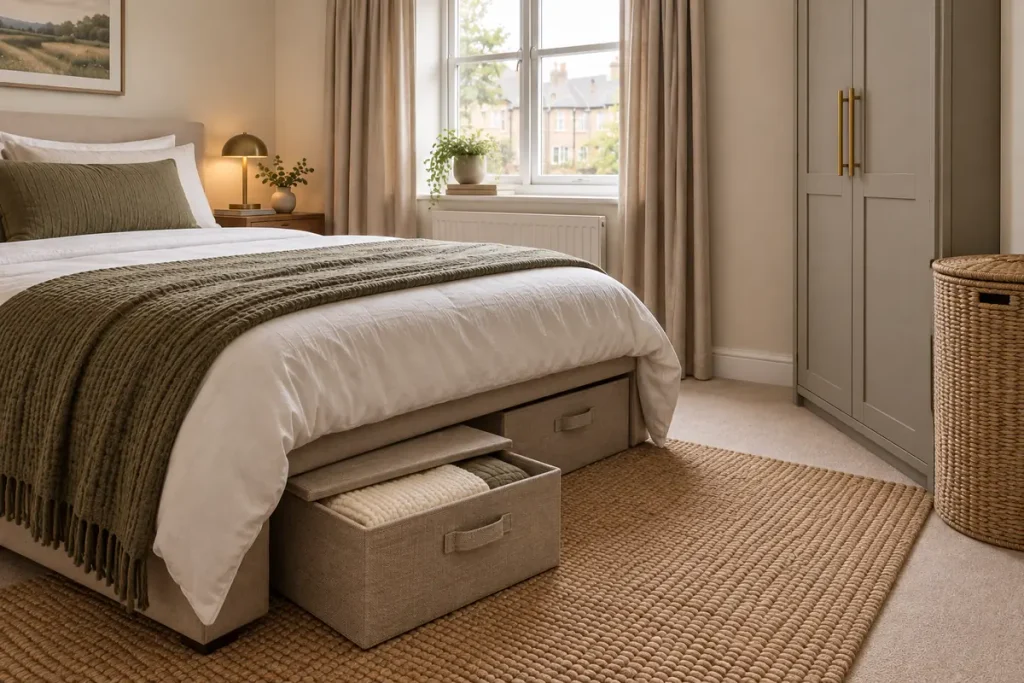
Let One Wall Work Hard, Then Give the Eye Somewhere to Rest
Advice for small rooms often says to use every inch of vertical space. Taken literally, that can leave every wall covered with hooks, shelves, cabinets and small artwork. The room gains storage but loses any visual pause.
Try concentrating the practical work instead. One wall might hold the wardrobe and the room’s main closed storage. Another wall, or even one generous section above a low piece, can stay quieter.
That emptier area is not wasted space. It is what allows the busy wall to look deliberate rather than desperate.
The same principle applies to art. Several tiny frames spread around the room create more edges for the eye to process. One substantial artwork, a textile panel, an upholstered headboard or a tight group of related frames can carry more personality with less visual noise. If a collected display suits your style, a focused corner wall gallery is easier to control than scattering pictures across every available gap.
Mirrors deserve similar thought. A mirror can reflect light and create a sense of depth, but it also repeats whatever is opposite it. Aim it toward a window, artwork or calm part of the room, not directly at the open wardrobe and laundry pile.
Secure tall or heavy pieces properly. The U.S. Consumer Product Safety Commission recommends anchoring furniture to help prevent tip-over injuries, particularly where children may be present. Use fixings appropriate for the wall and item, follow the manufacturer’s instructions and ask a professional when uncertain.
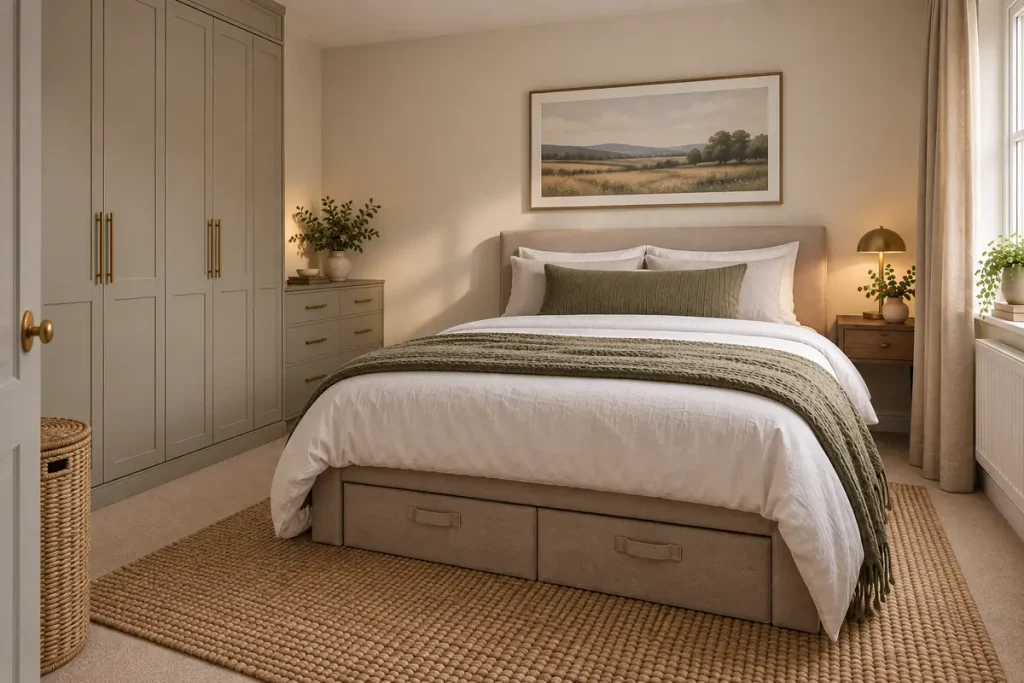
Wait Until Evening Before Deciding the Bedroom Is Finished
Many small bedroom ideas are judged at noon, even though the room does most of its work after dark.
A small bedroom can look bright at noon and feel flat at night. That is not a decor failure; it is usually a lighting plan trying to perform every job with one ceiling fixture.
Enter the room after dark and notice where the light is useful. Can you see inside the wardrobe? Is there a comfortable light for reading? Does the only lamp occupy most of the bedside surface? Is one corner disappearing into shadow while another is painfully bright?
Good bedroom lighting happens at different levels. The main light helps with entering, dressing and cleaning. A task light supports reading, getting ready or working. A softer evening light reduces the harsh jump between a bright ceiling and complete darkness.
You may already own enough lights. Move a lamp before buying one. Clean a dusty shade. Try a more suitable bulb where the fitting allows. If a table lamp consumes valuable surface space, a correctly installed wall-mounted or clip-on option may work better.
Keep cables out of the walking route, never run them beneath rugs and do not use damaged cords or overloaded outlets. New hard-wired fittings should be handled by a suitably qualified professional.
Now look at the color of the room under those lights. White is not compulsory. What often makes a small space feel chopped up is not darkness but a series of sharp, unrelated contrasts.
Related tones help the eye travel more smoothly. A warm off-white wall with oatmeal curtains, or an olive wall beside a slightly deeper wardrobe, can feel calmer than a pale room filled with high-contrast furniture. Darker colors can also work when they are repeated deliberately and supported by thoughtful lighting.
Current small-room design coverage from Homes & Gardens discusses color drenching and fine-scale pattern as ways to unify awkward walls and architectural lines. You do not need to follow a trend. The useful takeaway is that visual continuity can matter more than brightness alone.
Curtains can strengthen that continuity too. Where the window, ceiling and correct hardware allow, placing curtains higher and allowing the open panels to reveal more glass can improve the vertical line and preserve daylight. Ideal Home’s designer-backed guide explains why, without pretending that one fixed measurement suits every window.
Always test paint and fabric samples beside the room’s existing floor and furniture in both daylight and evening light. Screens are unreliable color judges.
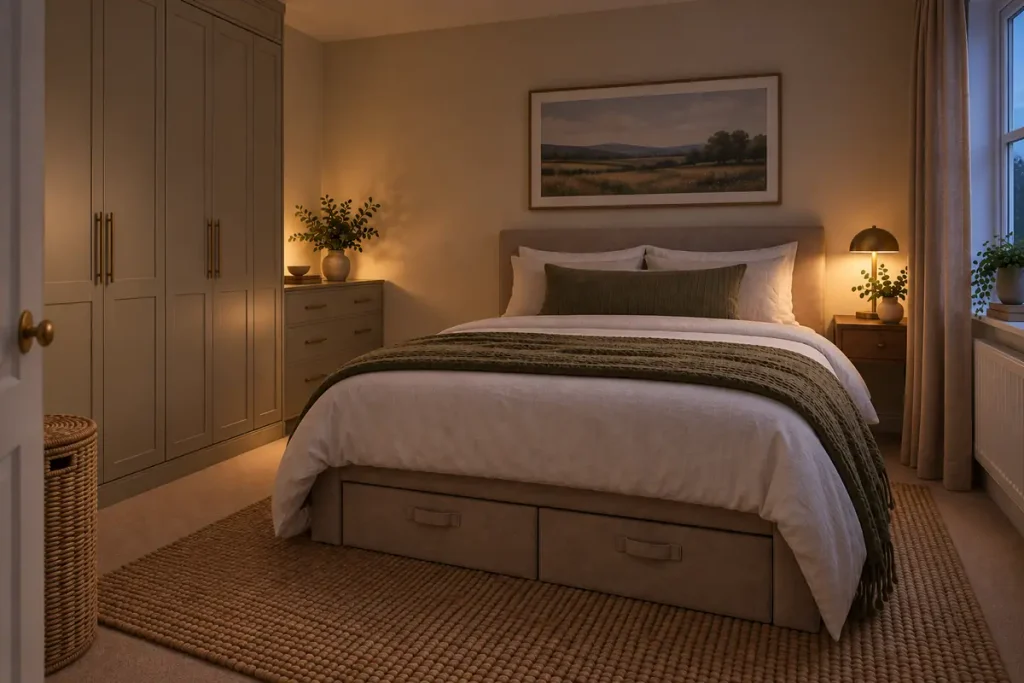
The Most Valuable Change May Be the Thing You Decide Not to Buy
Small bedroom ideas are often sold as products: a slimmer table, a storage bed, another organizer. But small rooms are unforgiving in a useful way; an object with no clear job reveals itself quickly.
Before buying furniture, lighting or storage, say exactly which repeated problem it will solve. “It is compact” is not a job. “It gives repeat-wear clothes a closed home beside the wardrobe” is a job. “It looks good in the product photo” is not a job. “Its drawer replaces the cluttered bedside surface” is a job.
There is plenty you can do tonight without spending anything. Clear the doorway view. Remove objects that belong in another room. Give laundry and repeat-wear clothes separate destinations. Group scattered decor. Move a useful lamp. Stop there and live with the change for a day.
Over a weekend, you might test a different bed position, improve cable control or move occasional items out of prime storage. Renters should check their lease and product instructions before drilling or using adhesive; some “removable” products can still lift paint when they come off.
If an existing piece genuinely needs replacing, replace the item causing the greatest friction rather than refreshing the whole room. That might mean one closed storage piece instead of several open units, a bedside drawer instead of a table or a bed with storage that can be accessed comfortably in the available layout.
Measure the real room, doorways and delivery route before ordering. Product photography cannot tell you whether a drawer will open beside your bed or whether a large item can turn through the hallway. Prices also change too quickly for a responsible article to promise that every solution fits one universal budget.
Give the Room Three Ordinary Nights
Do not call the bedroom finished on the same afternoon you rearrange it. Freshly cleared surfaces can make almost any layout look convincing for a few hours.
Use the room normally for three nights. Come in carrying the things you usually carry. Get ready for bed. Charge the phone. Open the wardrobe the next morning. Put away laundry when you are tired rather than when you are in decorating mode.
Notice what returns. If clothes settle on the same chair, their proper destination is still too inconvenient. If the new bedside arrangement sends a cable across the floor, the surface may be clear but the problem has only moved. If opening a drawer requires stepping around the bed, the layout is asking for a daily compromise that a photograph will never show.
Leave the harmless signs of life alone. A book beside the bed and a cardigan waiting to be worn again do not make a room badly designed. The target is not emptiness; it is a room in which useful things can appear without everything else collapsing around them.
After the third night, return to the doorway. The door should open without negotiation. Your eye should reach something calmer than the laundry. Everyday storage should be easier to access than seasonal storage, and the evening light should let you read or wind down without turning the room into a bright white box.
If you came here wondering how to make a small bedroom feel bigger, this is the less glamorous but more reliable answer: remove repeated friction before adding visual tricks. A mirror, pale wall or high curtain can support a room that already works. None of them can disguise a route that is blocked every morning.
The Bedroom Is Finished When It Stops Asking for Attention
A small bedroom does not need to pretend it is large. It needs to feel clear enough to enter, comfortable enough to sleep in and simple enough to reset when life gets busy.
Once those ordinary actions work, styling becomes enjoyable again. You can choose art because you love it rather than because a blank wall feels urgent. You can add texture without using it to hide clutter. You can explore these quiet luxury bedroom ideas knowing the room underneath the styling already makes sense.
Then stop. Let the bedroom become the background to your life instead of another project demanding constant improvement.
When you want visual references rather than another shopping deadline, save this guide and follow New Premium Picks on Pinterest.


2 Comments